I went to Bali for Research but found Grief
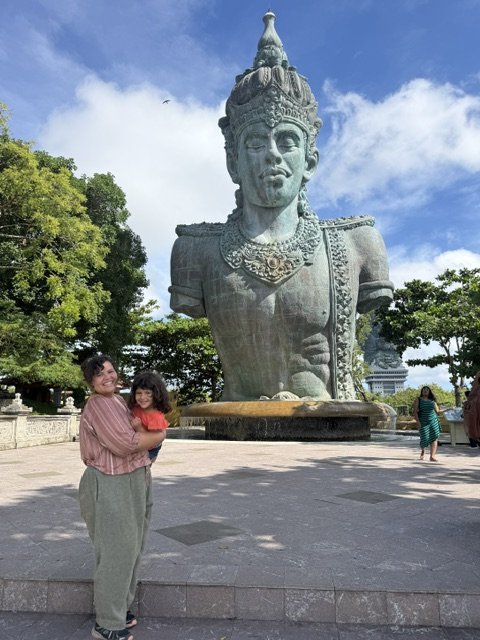
Garuda Wisnu Kencana Cultural Park
I wanted to understand what healing looks like in other cultural contexts, especially how children are included in spiritual and therapeutic spaces.
What I didn’t expect was how deeply it would surface grief.
Not only personal grief, but collective grief around separation: between adults and children, between healing and everyday life, between community and isolation.
At Pura Tirta Empul, a sacred water temple in Bali, my daughter had a full emotional release during a purification ceremony.
She cried, moved, and expressed big emotions in a public sacred space.
No one stopped their ritual. No one asked her to be quiet or removed.
Instead, people simply adjusted around her safety and continued their prayers.
There was no panic in the space. Only presence.
In many Western contexts, this would be considered disruptive.
But here, it was simply part of life.
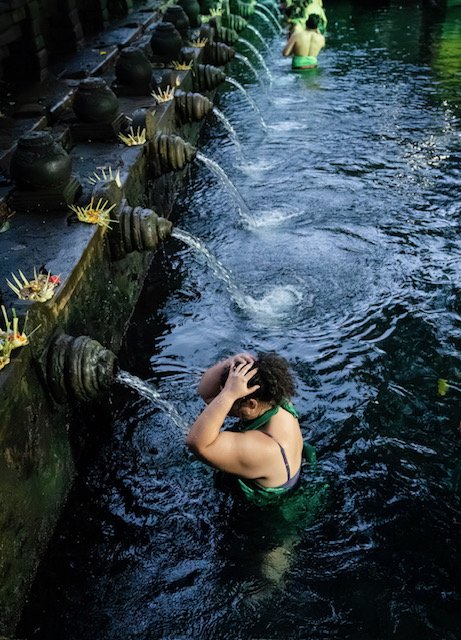
Melukat ceremony in Pura Tirta Empul
One of the most significant practices I witnessed was melukat, a Balinese water purification ritual.
Melukat involves entering sacred water to cleanse emotional, spiritual, and energetic imprints. It is often practiced at temples, rivers, or holy springs.
Water is understood not only as physical cleansing, but as a living medium of release and transformation.
Later on the trip during a visit to Tri Desna Healing, I met with local healers who welcomed my daughter as part of the space, not separate from it.
They played with her, supported her, and did not treat her presence as an interruption.
One practitioner told me:
“Never stop her from feeling her feelings.”
It was said so matter-of-factly that it felt like a worldview, not advice.
She proceeded to tell me how emotions need to flow, like water. Tears need to come, screaming is beneficial. We can learn a lot from water. Otherwise, the holder we hold on to our emotions the sicker we become. Here they teach you and children how to express these emotions without shame and in healthy ways.
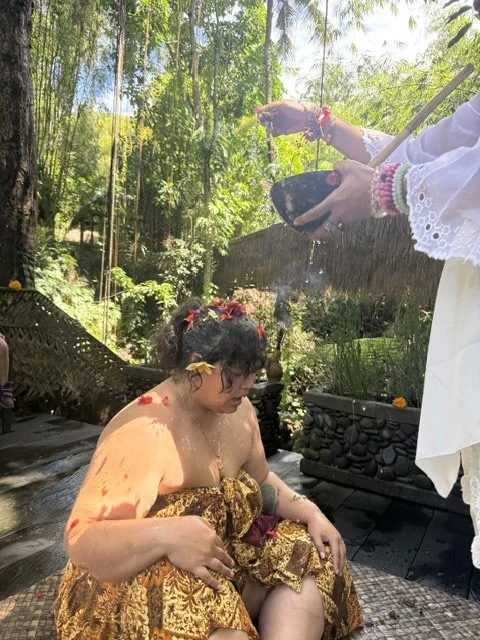
Tri Desna Healing
This trip made me reflect on what it means to belong as a mother.
For the first time in a long time, I did not feel like I was carrying motherhood alone.
I felt held in a broader field of people, place, and rhythm.
I noticed grief I didn’t know I was carrying.
Not only about motherhood.
But about separation.
Between children and spiritual life.
Between care and ritual.
Between belonging and survival.
And I left with a question I am still sitting with:
What would healing look like if children were never asked to be separate from it?